
What is the difference between clip-on and stick-on wheel weights?
Wheel weights may be small, but they play a big role in keeping your tires balanced and your ride smooth. When it comes to balancing, there are two main types of wheel weights: clip on wheel weight and stick on wheel weight. Understanding the differences between these options can help you choose the right solution for your vehicle.
1. Clip-On Wheel Weights
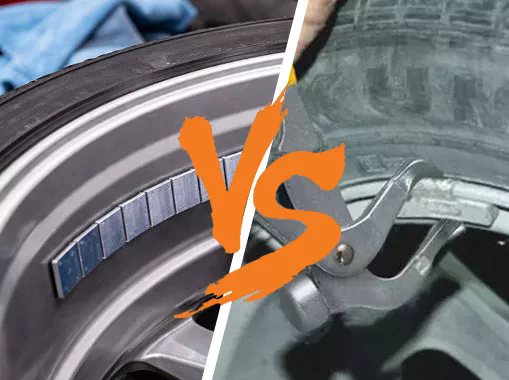
Clip-on weights are designed to attach directly to the rim edge of steel wheels. They are shaped to securely “clip” over the lip of the wheel, providing a reliable mechanical hold.
Advantages:
- Durable and secure: Once clipped, they rarely move or fall off.
- Easy to install and remove: Professionals can quickly adjust the weights during balancing.
- Cost-effective: Generally less expensive than adhesive weights.
Considerations:
- Only compatible with steel rims, not aluminum or alloy wheels.
- Can sometimes leave minor marks or scratches on the rim.
2. Stick On Wheel Weights
Adhesive wheel weights use a strong adhesive backing to stick to the inner surface of alloy or aluminum wheels. They are often small, rectangular, or trapezoid-shaped and are placed in specific positions determined by a balancing machine.
Advantages:
- Compatible with modern alloy wheels: Especially those with thin or decorative rims where clip-on weights aren’t suitable.
- Invisible from the outside: Maintains the wheel’s clean appearance.
- Flexible placement: Can be installed on virtually any section of the inner wheel surface.
Considerations:
- Adhesive may weaken over time in extreme heat, moisture, or harsh road conditions.
- Requires clean surface preparation to ensure proper adhesion.
3. Choosing Between Clip On and Stick on Weights
The choice often depends on your wheel type and driving needs:
- Steel wheels: Clip-on weights are usually preferred for their durability and ease of use.
- Alloy wheels: Adhesive weights are ideal for maintaining appearance and avoiding rim damage.
- High-speed driving: Either type works well if installed correctly, but clip-on weights may offer extra security on heavy vehicles.
| Comparison Item | Clip on Wheel Weights |
Stick on Wheel Weights |
| Fixing Method | Fastened by metal clip onto the inner rim edge | Attached via double-sided adhesive tape on flat inner wheel surface |
| Compatible Wheel Types | Steel wheels, traditional wheels with rim flange | Alloy wheels, modified wheels, tubeless wheels without rim flange |
| Installation Efficiency | Quick one-click installation; easy to remove and reusable | Requires clean surface before application; peel-and-stick, single-use only |
| Weight Accuracy | Standard accuracy, minor tolerance possible with clip structure | Higher accuracy, stamped thin steel with consistent stable weight |
| Impact on Wheels | Prone to scratching wheel finish, long-term wear at clip contact points | Damage-free installation, no scratch or harm to wheel surface |
| Material & Finish | Mostly iron with zinc plating / lead, one-piece stamped clip | Cold-rolled steel with electro zinc plating, paired with high-tack acrylic adhesive |
| Cost | Lower unit price, reusable, low overall cost | Slightly higher unit price, single-use only |
| Typical Applications | Commercial vehicles, trucks, economy sedans with steel wheels | Passenger cars, SUVs, modified vehicles, high-end alloy wheels |
| Key Advantages | Fast installation, reusable, low cost, ideal for mass maintenance | Wide wheel compatibility, damage-free, precise weight, clean appearance |
| Main Disadvantages | Damages wheel finish, limited compatibility, slightly higher high-speed drag | Non-reusable, strict surface cleanliness requirement, adhesive failure risk under extreme heat |
4. Key Takeaways
Both clip-on and adhesive wheel weights serve the same purpose: keeping your tires balanced for smooth driving, even tire wear, and improved vehicle safety. The main differences lie in installation method, compatibility, durability, and aesthetics. Choosing the right type ensures optimal performance and prolongs tire and wheel life.